Office cleaning tips are proven professional strategies for maintaining hygienic workspaces through systematic cleaning protocols, supply management, and strategic maintenance scheduling. Professional office cleaning tips address high-touch surfaces, clutter organization, and specialized area care, preventing workplace illness and exceeding 60% of employee absenteeism. Implementing effective office cleaning tips enhances productivity, protects employee health, and creates positive client impressions, supporting business success.

What Are Office Cleaning Tips?

Office cleaning tips are expert-recommended practices for maintaining clean, sanitary, and organized work environments through systematic approaches addressing contamination, clutter, and specialized cleaning challenges. These evidence-based strategies combine daily maintenance routines, supply organization methods, and professional techniques, preventing bacterial growth while improving workspace functionality. Effective office cleaning tips streamline cleaning processes, reducing time investment while delivering professional-quality results.

Why Office Cleaning Tips Matter

Professional office cleaning services implement systematic protocols that prevent disease transmission and maintain professional standards through consistent cleaning practices. Office cleaning tips reduce workplace illness by eliminating pathogens from surfaces where employees spend 40+ hours weekly, preventing healthcare costs exceeding industry averages. Neglecting proper cleaning allows bacterial accumulation, creating unprofessional appearances, damaging client relationships, and increasing employee stress and reducing productivity through contaminated, disorganized environments.

Clean workspaces provide immediate first impressions, influencing client decisions and business relationships. Odor-free, organized facilities demonstrate professional discipline and organizational values. Conversely, unclean offices suggest poor management and lack of attention, compromising business development opportunities and employee satisfaction.

Essential Office Cleaning Tips for Daily Success

Professional cleaning services implement systematic approaches, ensuring consistent results through proven methodologies addressing high-priority areas:

1. Designate Centralized Cleaning Supply Storage

Establish accessible storage areas consolidating all cleaning supplies, disinfectants, and equipment, enabling inventory tracking and preventing shortages. Keep comprehensive cleaning products, including EPA-registered disinfectants, all-purpose cleaners, microfiber cloths, and dusters readily available for immediate spill response. Centralized storage allows visual confirmation of stock levels, enabling timely reordering before critical shortages disrupt cleaning schedules.

2. Prioritize Client-Facing Public Areas

Focus intensive cleaning efforts on lobbies, reception areas, and client meeting spaces, creating positive first impressions. Vacuum and sweep public spaces minimum weekly maintaining a professional appearance while addressing high-traffic wear patterns. Dedicate special attention to restroom cleanliness—these facilities significantly influence client perceptions and employee satisfaction, requiring daily disinfection, supply replenishment, and odor control.

3. Implement Comprehensive Filing and Storage Systems

Create organized filing systems using cabinets and dividers, preventing desk clutter accumulation. Store bulky supplies, including paper reams, office supplies, and equipment, on designated shelving, maximizing workspace accessibility. Proper storage simplifies professional cleaning service access, enabling thorough deep cleaning without navigating obstacle courses of scattered materials.

4. Establish End-of-Day Desk Cleaning Routines

Develop habits of returning desk supplies, paperwork, and equipment to designated locations before leaving daily. Set reminders, ensuring adequate time for workspace organization, and preventing rushed morning arrivals. This practice provides psychological closure, benefiting employee wellbeing while enabling effective after-hours cleaning protocols, accessing all surfaces without obstacles.

5. Apply Top-Down Dusting Methodology

Start dusting from ceiling-level surfaces, including bookcase tops, ceiling vents, and wall-ceiling junctions, working systematically downward. This prevents redistributing settled dust onto previously cleaned surfaces. Address areas behind desks and electronics that attract significant dust accumulation. Include plant leaves in dusting routines, maintaining their air-purifying effectiveness while preventing particle buildup.

6. Organize Electrical Cords and Cables

Untangle and secure cords using cable management systems, reducing dust trap areas and simplifying vacuuming. Mount cables along desk edges or walls, keeping conductors off floors. Implement wireless technology where feasible, eliminating unnecessary cords. Organized cable systems transform cluttered workstations into easily maintained professional environments.

7. Strategically Place Adequate Waste Receptacles

Position trash and recycling bins throughout high-traffic areas and at individual workstations, encouraging proper disposal habits. Multiple convenient locations reduce clutter accumulation while promoting productivity through organized environments. Regular emptying prevents overflow, maintains a professional appearance, and prevents odor development.

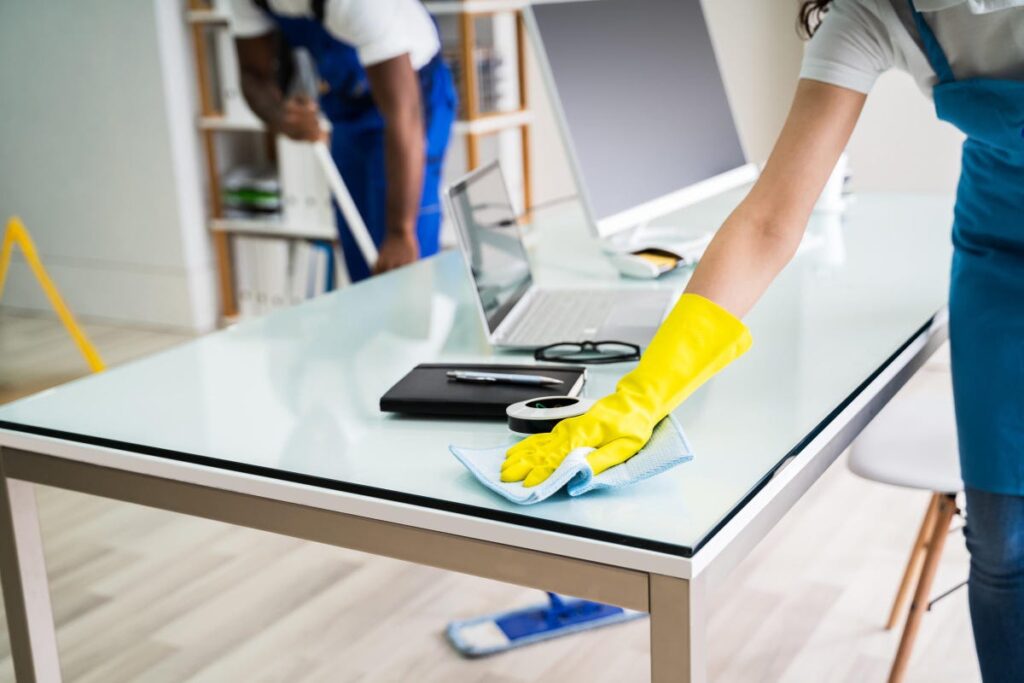
8. Systematically Disinfect High-Touch Surfaces

Clean door handles, telephones, keyboards, desks, and shared equipment daily using EPA-registered disinfectants. Contact time compliance ensures 99.9% pathogen elimination, preventing disease transmission. Proper disinfection protocols reduce workplace illness by 60%+ compared to irregular cleaning approaches. Simple all-purpose cleaners suffice for everyday spills while reserving disinfectants for contamination control.

9. Install Entrance Floor Mat Systems

Place commercial-grade floor mats inside and outside entrances, capturing 80% of tracked-in dirt before it reaches interior surfaces. Extended mats (6+ feet) provide optimal protection during inclement weather, preventing slip hazards from water, ice, or snow. Proper mat systems simplify floor maintenance while protecting flooring from accelerated wear, requiring expensive replacement.

10. Maintain Break Room Appliances and Refrigerators

Establish weekly refrigerator purging rotations, removing expired food, preventing odor, and bacterial growth. Deep clean refrigerators monthly using water-dish soap solutions. Wipe microwave interiors daily after use, preventing residue accumulation, attracting pests. Clean coffee makers weekly, including reservoirs, preventing mineral deposits and bacterial biofilm formation.

    These office cleaning tips integrate seamlessly into daily routines, delivering professional results without overwhelming time investments. Consistent application prevents contamination requiring extensive remediation while maintaining productive, healthy work environments.

    Office Cleaning Tips for Maintaining Professional Standards

    Consistent cleanliness delivers multiple organizational benefits beyond aesthetic improvements:

    • Positive Client Impressions: Clean workspaces create favorable first impressions, influencing business relationships and client decisions. Professional environments demonstrate organizational discipline and attention, supporting successful partnerships and contract negotiations.
    • Enhanced Employee Wellbeing: Odor-free, organized offices reduce employee stress while promoting focus and productivity. Clean environments prevent respiratory complaints, allergic reactions, and illness transmission, improving attendance and morale.
    • Pest Prevention: Regular cleaning eliminates food sources and harborage, preventing cockroach and termite infestations. Professional maintenance protects building infrastructure and expensive technology equipment from pest damage, potentially costing thousands in remediation and replacement.
    • Improved Indoor Air Quality: Systematic dusting and carpet maintenance reduce airborne particulates by 35%+, benefiting employees with asthma or respiratory sensitivities. Clean HVAC systems circulate filtered air rather than contaminated particles throughout facilities.
    • Workplace Safety Enhancement: Organized, clutter-free spaces prevent trip hazards and accessibility obstructions, reducing workplace injury liability. Proper cord management and clear pathways maintain compliance with safety regulations, protecting organizations from insurance complications.

    Professional office cleaning tips implementation prevents expensive emergency remediation while maintaining regulatory compliance and employee satisfaction, supporting long-term organizational success.

    Choosing Appropriate Cleaning Materials and Supplies

    Strategic product selection significantly impacts cleaning effectiveness and employee safety:

    • Thorough Research and Review Analysis: Investigate cleaning products through professional reviews and manufacturer documentation before purchasing. Online feedback identifies high-performing products while revealing common issues with ineffective formulations. Chemical ingredient research ensures compatibility with facility requirements and employee sensitivities.
    • Value-Based Product Selection: Balance cost considerations against effectiveness, avoiding extremely cheap products delivering poor results. Identify companies offering optimal value through competitive pricing without compromising quality. Local suppliers often provide superior pricing compared to national brands.
    • Sustainable and Eco-Friendly Options: Consider environmentally responsible products demonstrating organizational commitment to conservation. Green cleaning supplies appeal to environmentally conscious clients, potentially influencing business development. While initially expensive, sustainable products deliver long-term value through reduced environmental impact.
    • Water-Based Cleaning Solutions: Select water-based formulations for electronics and heat-generating equipment, preventing fire hazards associated with solvent-based alternatives. Water-based products have higher flashpoints, tolerating elevated temperatures without combustion risk. These formulations typically cost less while providing environmental benefits.
    • Fragrance-Free Product Implementation: Choose unscented cleaners accommodating employees with chemical sensitivities or respiratory conditions. Fragrance-free products prevent negative client reactions from overpowering scents. This consideration particularly matters for food service facilities, preventing nausea-inducing chemical odors.
    • Commercial-Grade Product Specifications: Select industrial-strength cleaners formulated for commercial environments rather than residential applications. Commercial products contain higher active ingredient concentrations, providing superior pathogen elimination. Specialized formulations exist for food processing facilities, healthcare environments, and industry-specific requirements.
    • Low-VOC and Allergen-Free Formulations: Source products without volatile organic compounds meeting state regulatory requirements for workplace safety. Verify products lack allergy-triggering ingredients, protecting employees and clients with sensitivities. Neutral formulations provide the broadest applicability across diverse user populations.

    Strategic supply selection enables effective cleaning while protecting employee health and demonstrating organizational responsibility, supporting positive brand perception and regulatory compliance.

    Professional Cleaning Service Advantages

    Organizations implementing office cleaning tips often discover limitations requiring professional expertise:

    • Experienced Professional Expertise: Professional cleaners possess specialized training, understanding proper techniques, product selection, and industry best practices. Employees lack commercial cleaning experience, often producing incomplete or inadequate results. Professional knowledge prevents costly mistakes while ensuring regulatory compliance.
    • Cost-Effective Resource Allocation: Outsourcing eliminates equipment purchases, supply inventory management, training programs, and employee time diversion. Professional services provide supplies, equipment maintenance, and efficient execution. Total ownership cost analysis typically favors professional partnerships over in-house approaches.
    • Enhanced Business Value: Professional services source commercial-grade supplies at wholesale pricing unavailable to individual businesses. Prepared teams complete work independently without requiring supervision or coordination. Quality execution and efficiency increase organizational value without budget strain.
    • Operational Convenience: Flexible scheduling accommodates operational hours, enabling after-hours cleaning, preventing workflow disruption. Professional services maintain consistency regardless of employee absences, competing priorities, or organizational changes. This reliability ensures facilities remain ready for business daily.
    • Superior Equipment Access: Professional services utilize HEPA-filter vacuums, commercial extractors, electrostatic sprayers, and specialized equipment costing $50,000+, unavailable to most organizations. Advanced tools deliver deeper cleaning and superior pathogen elimination unattainable with consumer-grade equipment.

    Professional cleaning partnerships enable organizations to focus on core competencies while maintaining exceptional facility conditions supporting employee health, client impressions, and operational excellence.

    Office Cleaning Tips Comparison by Approach

    Different cleaning strategies offer distinct advantages based on organizational needs and resources:

    ApproachTime InvestmentSupply CostsQuality LevelEmployee ImpactBest Application
    Employee Daily Tasks20-30 min/person dailyLow-moderate60-70% effectiveHigh burden, reduced moraleSmall offices <5 employees
    Weekly Employee Deep Clean4-6 hours weeklyModerate70-75% effectiveSignificant burdenBudget-constrained small offices
    Bi-Weekly Professional ServiceMinimal employee timeService fee only85-90% effectiveMinimal burdenMedium offices balancing cost-quality
    Weekly Professional ServiceMinimal employee timeService fee only90-95% effectiveMinimal burdenHigh-traffic or client-facing facilities
    Hybrid Daily + Pro Monthly10-15 min/person dailyLow + service fee95%+ effectiveMinimal burdenOptimal cost-effectiveness balance

    Professional services deliver consistent results through systematic protocols, specialized training, and commercial equipment unavailable through employee-based approaches requiring significant time diversion from revenue-generating activities.

    Variation by Facility Type

    Office cleaning tips adapt to specific workplace characteristics and operational requirements:

    • Small Professional Offices: Focus on essential high-impact areas, including reception spaces, restrooms, and client meeting rooms. Employee participation handles daily tasks with quarterly professional deep cleaning, maintaining standards within limited budgets. Prioritize client-facing spaces over back-office areas when resources constrain comprehensive cleaning.
    • Medium Corporate Offices: Implement hybrid approaches combining employee daily maintenance with weekly professional services. Dedicate enhanced resources to executive areas, conference facilities, and reception spaces. Monthly professional deep cleaning addresses carpets, HVAC systems, and specialized needs beyond regular maintenance capabilities.
    • Large Corporate Campuses: Employ dedicated custodial staff or comprehensive professional service contracts, ensuring systematic coverage across extensive facilities. Zone-based cleaning prevents overlooked areas through assigned responsibilities and verification systems. Daily professional services maintain consistent standards regardless of employee variability or competing priorities.
    • Medical and Professional Service Firms: Exceed standard cleaning with healthcare-grade disinfectants and multiple daily disinfection cycles. Maintain confidential document discretion during cleaning operations. After-hours scheduling prevents client meeting disruption while maintaining impeccable presentation standards supporting professional reputations.
    • Creative and Technology Workspaces: Address open floor plans facilitating rapid contamination spread through enhanced disinfection frequencies. Clean extensive electronics using specialized products, preventing moisture damage. Accommodate unconventional work hours with flexible cleaning schedules. Integrated break areas require frequent attention to prevent odor issues in shared spaces.

    Each facility type presents distinct challenges requiring customized office cleaning tips that maximize effectiveness while respecting operational constraints, professional standards, and budget limitations.

    Get Professional Office Cleaning Tips Services from Dallas Janitorial Services

    Why risk workplace illness and unprofessional appearances when systematic office cleaning tips prevent disease transmission and enhance client relationships? Professional protocols reduce employee absenteeism by 60%+ while creating environments that attract clients and supporting business development. Dallas Janitorial Services implements comprehensive office cleaning tips customized to facility requirements and operational constraints throughout Dallas-Fort Worth. Contact us today at 214-778-3689 for professional office cleaning assessment, implementation, and ongoing service excellence.

    FAQs About Office Cleaning Tips

    What are the most effective office cleaning tips for daily maintenance?

    The most effective daily office cleaning tips include disinfecting high-touch surfaces (door handles, phones, keyboards), emptying trash and recycling bins, maintaining restroom cleanliness, organizing desk supplies, and addressing spills immediately. These essential tasks require 20-30 minutes per employee, preventing bacterial accumulation, causing workplace illness.

    Consistent daily attention eliminates conditions requiring extensive remediation while maintaining professional appearance for clients. Strategic waste bin placement and centralized supply storage enable efficient task completion without workflow disruption.

    How can office cleaning tips improve employee productivity?

    Office cleaning tips improve productivity by reducing illness-related absenteeism by 60%+, eliminating distractions from unclean environments, and creating organized spaces supporting focus and concentration. Clean workspaces reduce employee stress, improve morale, and demonstrate organizational commitment to wellbeing.

    Studies show that organized, clean facilities correlate with 20%+ productivity improvements through enhanced cognitive performance and reduced sick days. Professional cleaning protocols prevent odor problems, pest issues, and visible contamination, compromising employee comfort and operational efficiency.

    What supplies are essential for implementing office cleaning tips?

    Essential supplies for office cleaning tips include EPA-registered disinfectants effective against common pathogens, all-purpose cleaners for general surfaces, glass cleaners, microfiber cloths, HEPA-filter vacuums, and mops. Personal protective equipment, including gloves and eye protection, prevents chemical exposure injuries.

    Commercial-grade products provide superior results compared to residential formulations. Water-based cleaners suit electronics cleaning, while fragrance-free options accommodate employee sensitivities. Centralized storage with inventory tracking prevents supply shortages, disrupting maintenance schedules, and enabling consistent cleaning execution.

    Should small businesses implement office cleaning tips internally or hire professionals?

    Small businesses should evaluate total costs by comparing in-house office cleaning tips implementation against professional service fees. Consider employee time opportunity costs, supply expenses, equipment investments, training requirements, and quality consistency. Professional services provide specialized equipment, trained staff, commercial products, and reliable results, freeing employees for revenue-generating activities.

    Hybrid approaches combining employee daily tasks with periodic professional deep cleaning often deliver optimal cost-quality balance for organizations under 10 employees managing with internal protocols, while larger facilities benefit from professional partnerships.

    How do office cleaning tips address workplace illness prevention?

    Office cleaning tips prevent workplace illness through systematic disinfection of high-touch surfaces harboring pathogens, proper contact times ensuring 99.9% bacterial elimination, and daily cleaning of restrooms and kitchen areas. EPA-registered disinfectants eliminate influenza viruses, norovirus, and common bacteria transferred between employees.

    Proper protocols reduce sick days by 60%+ compared to irregular cleaning. Floor mat systems capture 80% of outdoor contamination, preventing pathogen introduction. Professional implementation ensures consistent execution, maintaining sanitary conditions, protecting employee health, and reducing healthcare costs.

    What office cleaning tips are most important for client-facing businesses?

    Client-facing businesses prioritize reception areas, lobbies, conference rooms, and restroom facilities, creating positive first impressions. Odor control through proper ventilation and waste management prevents negative perceptions. Daily surface disinfection, weekly vacuuming in public spaces, and strategic storage preventing visible clutter maintain professional standards.

    Glass cleaning on entrance doors and windows enhances natural light while demonstrating attention to detail. Professional service partnerships ensure consistent quality regardless of staff availability, supporting business development through impeccable presentation during client visits and negotiations.

    How often should businesses update their office cleaning tips and protocols?

    Businesses should review office cleaning tips and protocols quarterly and update when facility changes occur, new health guidelines are issued, employee feedback indicates gaps, or cleaning quality becomes inconsistent. Seasonal adjustments address challenges like increased floor maintenance during winter or enhanced dusting during allergy seasons.

    Regulatory changes may require protocol modifications to ensure compliance. Regular updates maintain relevance to current facility conditions, employee needs, and professional standards. Pilot test protocol changes in limited areas before full implementation, identifying practical issues requiring additional refinement.

    What office cleaning tips specifically address high-touch surface disinfection?

    High-touch surface disinfection office cleaning tips require EPA-registered disinfectants applied with proper contact times (typically 30 seconds to 10 minutes), ensuring pathogen elimination. Clean door handles, light switches, elevator buttons, telephones, keyboards, and shared equipment daily minimum.

    High-traffic periods require multiple disinfection cycles. Use electronics-safe products (70% isopropyl alcohol), preventing moisture damage to sensitive components. Unidirectional wiping prevents recontamination. Replace cleaning cloths frequently, avoiding cross-contamination between areas. Systematic protocols reduce disease transmission by 60%,+ maintaining healthier work environments.

    Posted in