Hantavirus is a family of viruses spread to humans primarily through contact with rodent urine, droppings, saliva, or nesting materials, most often when contaminated dust becomes airborne and is inhaled. The CDC reports a few dozen US cases per year, concentrated in Western states. Texas is not a hantavirus hotspot. But rodent activity in commercial spaces is common, and how you clean up after it matters. Sweeping or vacuuming rodent contamination can aerosolize particles and spread pathogens through the air.
This guide covers what experts at the CDC, OSHA, and the cleaning industry actually recommend for hantavirus contamination cleanup in commercial spaces, when in-house cleanup is acceptable, and when to call a professional.
What Hantavirus Is and How It Spreads
Hantavirus is not one disease; it is a family of viruses. Different strains exist in different parts of the world. In the Americas, strains that infect humans can cause hantavirus pulmonary syndrome (HPS), a respiratory illness. According to the CDC, HPS has a case fatality rate of approximately 38% among patients with severe respiratory symptoms. Symptoms typically appear between 4 and 42 days after exposure.
Transmission occurs almost exclusively through contact with infected rodents, typically via their urine, droppings, saliva, or nesting materials. The most common route is breathing in airborne particles when contaminated dust gets stirred up during cleaning or movement. Direct contact with droppings or a rodent bite can also transmit the virus, though that is far less common.
One important note for context: the Andes virus strain making news in 2026 is endemic to South America, not the United States. The hantavirus strain that occurs in the US (Sin Nombre virus) is most common in the Western states. Texas sees very few cases. The cleanup protocols below apply regardless; they protect against hantavirus and other rodent-borne pathogens that are more common in commercial settings.
Is Hantavirus a Real Risk for Texas Businesses?
Honest answer: hantavirus itself is rare in Texas. The CDC tracks hantavirus cases nationally, and Texas reports only a handful over multi-year periods. Health authorities are actively monitoring several US states for the 2026 Andes-strain outbreak linked to a South American cruise ship, but those passengers are not spreaders. The risk of a Texas business encountering an active hantavirus case is low.
Rodent contamination in commercial spaces, however, is common. And while hantavirus is rare, rodent contamination carries other risks that are not, leptospirosis, salmonellosis, lymphocytic choriomeningitis, and plain old bacterial contamination from feces in food prep or sensitive areas. The reason the CDC’s hantavirus cleanup protocol exists is that it works against all of these. Treating rodent contamination as a biohazard, regardless of whether hantavirus is specifically present, is the safe and standard approach.
In other words, do not clean up rodent droppings because you are worried about hantavirus specifically. Clean them up the way experts recommend because rodent contamination is contamination, and the cleanup method matters.
Why Rodent Droppings Are a Cleaning Problem, Not Just a Pest Problem
Pest control removes the rodents. It does not decontaminate the space. Once rodents have been in an area, their urine, droppings, and nesting materials remain, often in places that are not obvious, like behind appliances, in ceiling voids, inside HVAC ductwork, or under stored inventory.
This matters because rodent contamination outlasts the rodents themselves. Dried droppings retain biological hazards for weeks. Disturbing them, sweeping, vacuuming, and moving boxes that have sat on top of them can release particles into the air. In a commercial space with employees, customers, or sensitive operations like food service, that is a real exposure risk that has nothing to do with whether hantavirus specifically is present.
This is why facility managers should treat rodent contamination as a cleaning and decontamination problem, not just a pest problem. After pest control finishes, the space still needs proper cleanup. Our commercial disinfecting services handle this exact scenario.
What Experts Recommend: The CDC Approach to Rodent Cleanup
The CDC’s official cleanup guidance follows a wet-cleaning method that prevents particles from going airborne. The same protocol applies in commercial settings, with additional PPE for heavier contamination. Here is what the CDC recommends.
Before You Start
Trap any active rodents and seal entry points first. If no rodents are captured for a week, the active infestation is gone. Ventilate the affected space by opening doors and windows for at least 30 minutes before anyone enters to clean. Leave the area during this airing-out period.
The 5-Step CDC Wet Cleaning Method
- Put on rubber or plastic gloves. For light contamination in a small area, household gloves are acceptable. For heavier contamination, see the PPE section below.
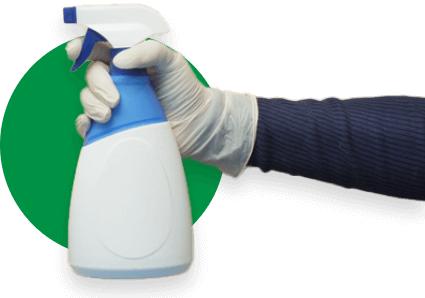
- Spray urine and droppings until very wet with a bleach solution (1 part bleach to 9 parts water) or an EPA-registered disinfectant. Make sure the disinfectant label includes the word “disinfectant.” Let it soak for at least 5 minutes, or longer if the disinfectant label specifies.
- Wipe up with paper towels. Do not sweep. Do not vacuum. The wet material gets picked up with disposable towels.
- Dispose of paper towels in a sealed garbage bag that gets emptied promptly. For heavy contamination, double-bag.
- Mop or sponge the area with disinfectant. Clean all surrounding hard surfaces, floors, countertops, cabinets, and drawers. Wash any contaminated bedding, fabrics, or upholstery in hot water with detergent. Steam clean carpets that show evidence of rodent activity.
Remove gloves last and wash hands thoroughly with soap and water.
Why You Should Never Sweep or Vacuum Rodent Droppings
This is the single most important rule in rodent cleanup, and it is the one most often violated.
Sweeping or vacuuming dry rodent droppings, urine, or nesting materials releases microscopic particles into the air. If hantavirus or other pathogens are present, those particles are exactly how transmission happens. The CDC explicitly warns against dry sweeping or vacuuming for this reason.
Standard HEPA vacuums are not a workaround. Even with HEPA filtration, the act of vacuuming disturbs the contamination and creates airflow that can spread particles before the filter captures them. Wet cleaning, saturating the material first so it stays heavy and damp, is the only safe method.
If a building maintenance crew has already swept or vacuumed contaminated material, the area needs re-cleaning using the wet method, and someone needs to check the ventilation system. This is one of the most common reasons commercial properties call a professional cleaning service for rodent remediation.
The Professional Cleanup Process for Commercial Rodent Contamination
For heavy contamination, contaminated HVAC systems, large areas, or facilities with sensitive operations (food service, medical, child care), the CDC recommends professional remediation with enhanced PPE and protocols. Here is what that looks like in practice.
PPE for Heavy Commercial Contamination
The CDC’s heavy-contamination protocol calls for:
- Half-face air-purifying respirator with N100 or HEPA cartridges, or a powered air-purifying respirator (PAPR) for higher-risk situations
- Disposable coveralls (Tyvek or equivalent)
- Rubber or plastic gloves, taped to coveralls at the wrists to prevent gaps
- Non-vented eye goggles
- Rubber or plastic boots, or disposable boot covers
Regular dust masks (surgical masks, KN95s, N95s) are not adequate for heavy rodent contamination. The N100 rating is the threshold for filtering the small particles that carry hantavirus.
The Process
A professional cleanup follows roughly this sequence:
- Site Assessment: Walk the space, identify all contamination zones (including hidden areas like ceiling voids, behind equipment, inside HVAC), and scope the work.
- Ventilation and Containment: Open the affected area to outside air for 30 minutes minimum. Isolate the contamination zone from clean areas with poly sheeting where needed.
- PPE on, Exterior Surfaces Wetted: The cleaning crew suits up before entering the contaminated area. All contaminated surfaces get saturated with EPA-registered disinfectant or bleach solution before any material gets touched.
- Removal with Hand Tools, Not Power Tools: Heavy contamination requires shovels or wet mops, never brooms or dry vacuums. Material goes directly into sealed plastic bags.
- Surface Disinfection: The crew cleans every hard surface in the affected zone with disinfectant after material removal. Soft surfaces, carpets, upholstery, and fabric storage get steam cleaned or replaced depending on contamination level.
- HVAC Inspection: If rodents accessed ductwork, HVAC contamination is likely and requires separate remediation.
- Final Disposal: The crew double-bags all contaminated waste and disposes of it according to local biohazard waste rules. PPE that came into direct contact gets treated as contaminated waste.
- Documentation: A professional cleaning vendor documents the scope, methods, and disposal. This is important for liability, insurance claims, and health department records.
Common Commercial Spaces Where Rodent Contamination Happens
Some commercial environments are far more likely to develop rodent contamination than others. If you operate one of these spaces, regular inspection is part of the job.
- Restaurant back-of-house, dry storage, behind equipment, under refrigeration, near grease traps
- Warehouse and distribution facilities, palletized storage, loading docks, dock plate gaps, mezzanines, the Alliance corridor’s heavy distribution density makes this category particularly common in DFW
- Food and beverage processing facilities, anywhere with grain, ingredients, or packaging in bulk
- Vacant tenant space, empty offices, or retail that sat unoccupied for months, especially with utility shutoffs
- Utility rooms, mechanical rooms, and electrical closets
- Ceiling voids and drop ceiling plenums are common runway spaces for rodents moving between zones
- Older buildings with deferred maintenance, gaps in walls, foundations, or utility penetrations
If your facility falls into one of these categories, ongoing janitorial services combined with periodic disinfecting work create the protection you actually need. Cleaning that ignores the conditions where rodents thrive is cleaning that fails.
Prevention: What Facility Managers Should Do Year-Round
Cleanup is reactive. Prevention is what keeps you from needing cleanup in the first place. The basics are not complicated, but they require consistency.
Seal Entry Points
Rodents enter through gaps as small as a quarter-inch. Inspect exterior walls, foundation lines, utility penetrations, dock plate seals, and roof edges quarterly. Seal what you find.
Eliminate Food Sources
Empty trash receptacles on a schedule. Store food, grain, and packaged goods off the floor in sealed containers. Clean up spills the same day.
Eliminate Water Sources
Fix plumbing leaks promptly. Check for condensation around refrigeration. Rodents need water as much as food.
Maintain Landscape Buffers
Keep vegetation, mulch, and storage at least 18 inches away from exterior walls. Trim tree branches that overhang the roofline.
Schedule Regular Inspections
Pest control should walk the property monthly at a minimum, more often for high-risk facilities like restaurants and warehouses.
Pair Pest Control with Cleaning Protocols
Pest control removes the animals; janitorial services prevent the conditions that attracted them. The two work together, not in isolation.
When to Call a Professional vs. Handle It In-House
Not every rodent sighting requires a professional. Here are clear criteria for when in-house cleanup is appropriate and when it is not.
In-House Cleanup Is Usually Acceptable When:
- Contamination is limited to a small, accessible area (a single shelf, drawer, or corner)
- There are fewer than a dozen droppings
- No nesting materials, dead rodents, or urine pooling are present
- The area is well-ventilated and easily isolated
- Your staff has appropriate PPE (gloves, mask) and knows the wet-cleaning method
- The contamination is not in a food preparation area, medical space, or HVAC system
Call a Professional When:
- Contamination is widespread or covers a large area
- Heavy droppings, nests, or dead rodents are present
- The HVAC system, ductwork, or ceiling void shows signs of rodent activity
- The space is a food preparation area, medical facility, child care center, or other sensitive environment
- Someone has already swept or vacuumed the contamination (which means particles are now airborne)
- Insulation or other porous materials are contaminated
- Your staff lacks proper PPE (especially N100 respirators) or training
- The contamination requires biohazard disposal documentation for insurance or health department purposes
When in doubt, call. Professional cleanup is not expensive relative to the liability of mishandled contamination. We can offer you a no-pressure consultation on what your facility actually needs.
Request a Commercial Cleanup Consultation From Dallas Janitorial Services Today
Rodent contamination is not a problem your facility should handle with brooms, household vacuums, or hopeful spraying. The CDC’s protocols exist because the wrong cleanup method makes things worse.
Dallas Janitorial Services has operated across DFW since 2006, and we handle commercial rodent decontamination as part of our standard disinfecting work, with the PPE, process, and documentation required for the job.
Schedule a site assessment for your commercial property anywhere in Dallas, Fort Worth, Allen, or Plano.
Frequently Asked Questions
Is hantavirus dangerous?
Yes, hantavirus pulmonary syndrome has a case fatality rate of approximately 38% among patients with severe respiratory symptoms, according to the CDC. But hantavirus itself is rare. The US sees a few dozen cases per year, mostly in Western states. The risk for a Texas business is low. The cleanup protocols matter regardless because they also protect against more common rodent-borne pathogens like leptospirosis and salmonella.
Can I just vacuum up rodent droppings?
No. The CDC specifically warns against sweeping or vacuuming dry rodent droppings, urine, or nesting materials. Doing so releases particles into the air that can carry hantavirus and other pathogens. The wet-cleaning method, saturating with disinfectant before wiping up with paper towels, is the only safe approach.
What disinfectant kills hantavirus?
A 10% bleach solution (1 part bleach to 9 parts water) or any EPA-registered disinfectant labeled as effective against viruses. Saturate the contaminated material until very wet and let it soak for at least 5 minutes before wiping it up. Follow the specific contact time on the disinfectant label.
How long does hantavirus survive in dried droppings?
Hantavirus can survive for several days outside a host under the right conditions, though it degrades faster in heat, sunlight, and dry air.
Is the hantavirus outbreak a risk in Texas?
Not directly. The 2026 outbreak involves the Andes virus strain, which is endemic to South America and not found in US rodent populations. The cruise ship passengers being monitored in several US states (including Texas) are not contagious in the way COVID was, even the Andes strain requires close, prolonged contact for the rare human-to-human transmission documented in past outbreaks. The current public health risk to Texas businesses from this specific outbreak is extremely low.
Does pest control handle cleanup?
No. Pest control removes the rodents. It does not decontaminate the space afterward. After pest control is finished, the urine, droppings, and nesting materials remain, and that is the contamination that poses a health risk.
How quickly can a professional cleaning service respond to a rodent contamination situation?
Response times depend on the scope and the vendor. For commercial situations, expect a same-day or next-day site assessment, with cleanup scheduled based on the size of the contaminated area, PPE and equipment needs, and whether the space can be isolated during work. We respond to rodent contamination calls within 24 hours for DFW commercial clients.
What does professional rodent contamination cleanup cost?
Pricing depends on the size of the contaminated area, the level of PPE required, whether HVAC remediation is needed, and disposal requirements. Light surface contamination in a small area is straightforward. Heavy contamination across a large facility, especially when HVAC is involved, costs significantly more. We provide quotes after a site assessment, no flat rates, because no two contamination jobs are the same.